
One would assume the person going by the name Dolphin Dave would be a conservationist of marine life or maybe a cetacean campaigner. You know, someone who is concerned about the well-being and safety of aquatic animals and takes all reasonable precautions to keep them safe from danger or stress. David Jiménez, often known as Dolphin Dave, a resident of Maui, seems to disagree.

What exactly did he do to provoke a recent citation from Hawaiian authorities who said he was bothering a humpback whale and a pod of dolphins?
Concerned residents called Hawaii’s Division of Conservation and Resources Enforcement (DOCARE) several times to complain that local wildlife was being threatened. An elderly man, later identified as David, 65, informed local officials that Dvid Kiminez Jiménez was seen following a young humpback whale inside Kealakekua Bay State Heritage Park.
But it didn’t end there. There was video evidence to support the claims, as there usually is these days. According to reports, DOCARE agents saw a video of Jiménez snorkeling very near a baby humpback whale, practically brushing its fin.

Officers from DOCARE were able to catch Mr. Jiménez leading a group of swimmers who were allegedly chasing a pod of spinner dolphins once they reached land. Little spinner dolphins are a species of dolphin that can be found worldwide in tropical off-shore waters. They are well known for their acrobatic feats in which they leap through the air while rotating around their longitudinal axis.
They “are perhaps the most often observed cetacean in nearshore seas in the Pacific Islands,” according to NOAA Fisheries.
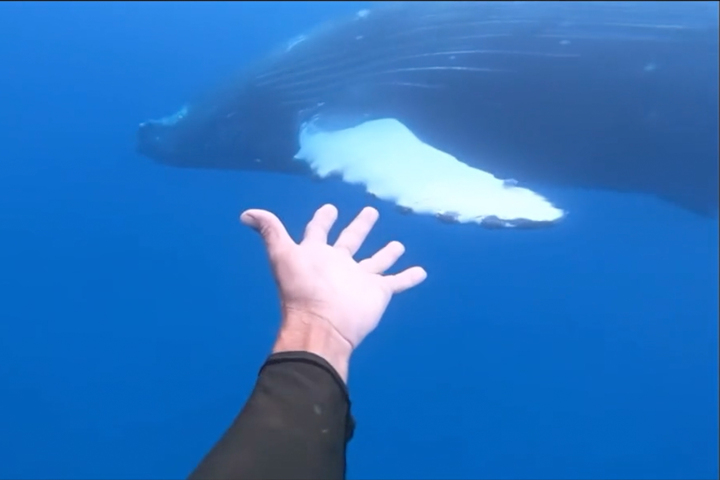
Jiménez received a ticket for breaking the administrative rules of Hawaii. They include harassing animals in a state park and engaging in forbidden behavior about endangered whale species. An appearance in court summons was included with the citations.

Jiménez, who is known online as “Dolphin Dave,” told police that he will continue to swim with whales and dolphins despite obtaining the penalties because “it’s magical and others do far worse things.”
Humpback whales are protected by the National Marine Sanctuaries Act in addition to Hawaii’s state regulations.
The National Oceanic and Atmospheric Administration warns people to stay a safe distance from whales and other animals at all times and to never, ever approach them.


